
Soulful strains of classical music wafted through the chilly air as the ninth edition of the Zee Jaipur Literature Festival kicked off in Jaipur on Thursday at its usual venue, the sun-kissed Diggi Palace grounds, amid elaborate security arrangements.

United States Secretary of State John Kerry will travel to India on June 23 to co-chair the 4th India-US strategic dialogue, his spokesperson said on Wednesday.

'I would urge my Indian friends to look at how significant the overall support was.'

India and Japan on Friday sought a peaceful solution to the territorial disputes in the strategic South China Sea, saying parties involved in the matter must not resort to "threat or use of force", in remarks that could anger China which is opposed to any outside interference.

Since the 1984 national elections, no party has won a clear majority in the lower house of Parliament, a US intelligence report has observed. Vicky Nanjappa reports.
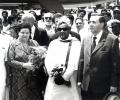
'I was present at a meeting where he decided to permit the IAF to strike at Pakistan positions in Kargil, with the caveat that they should not cross the LoC.' 'Confident that the Indian Army would succeed, Mr Vajpayee was positioning himself to tell the world after the Kargil conflict was won that India did not violate the 'sanctity' of the LoC,' recalls Ambassador G Parthasarathy, who served as India's envoy in Islamabad in that eventful year, 1999.

Aziz Haniffa/Rediff.com listens to four Indian and American national security advisers recalling the hard work that went into negotiating the nuclear deal.

Why do investors need a broker to buy stocks which were dematerialised long ago and can be delivered directly into their accounts?

There are many reasons for Japan to turn a deaf ear to its anti-nuclear lobby and concentrate on its geo-strategic imperatives to sign the nuclear deal with India, says Debalina Ghoshal.
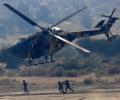
'Given the present force levels, India cannot fight and win.' 'India can't hope to terminate the conflict on India's terms and impose the nation's will upon the adversaries,' says Brigadier Gurmeet Kanwal (retd).
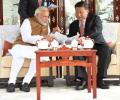
'Till today, we don't know what PM Modi discussed with Xi Jinping and Vladimir Putin, but we have been told that the relations have been reset.' 'We have no evidence from China to show that anything has changed, even though India had made several gestures in preparation for Wuhan,' says Ambassador T P Sreenivasan.

'US-Indian relations will become an important part of Trump's diplomacy,' says Global Times.

'We rarely choose to fight when the threat is still a nascent threat. When we do fight, we fight when the invaders reach Panipat and are preparing to knock on the gates of Delhi.'

Here is the full text of the joint statement issued by India and the US.
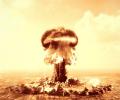
The new government must initiate a comprehensive review of India's nuclear weapons doctrine and posture. Ajai Shukla explains

India and France on Monday inked an Inter-Governmental Agreement on the sale of 36 French fighter jets, Rafale, but were unable to sign the final deal due to some "financial" aspects, which are expected to be sorted out in "couple of days".

'This is a tragedy that must be stopped.'

'The domination of American foreign policy by the military poses some hidden dangers for us.' 'We must factor in that the Pakistani military and the US military have close ties going back three generations.' 'Pakistan will find sympathetic ears in the Pentagon against India as the bogey man.' 'This will be further milked to the maximum by raising the ante in Kashmir through its proxies,' warns Colonel Anil A Athale.

'Trump forgets that Kim is not one who likes to be treated publicly as a pauper; he wants to come to the table as an equal, and from a position of perceived strength, not as a suppliant,' says Dr Rajaram Panda.

It asked all nations to work together to expedite the adoption of the Comprehensive Convention on International Terrorism in the UN General Assembly without any further delay.

This is the joint statement issued by the ministry of external affairs on the visit of US President Barack Obama to India.

The two countries also asked all nations to stop cross-border movement of terrorists and asserted that a decisive collective response from the international community without 'double standards and selectivity' was required to combat the threat of terrorism.

Moving ahead with their new mantra -- Chalein Saath Saath: Forward Together We Go -- Prime Minister Narendra Modi and United States President Barack Obama on Tuesday vowed to deepen cooperation in every sector for the benefit of global stability and people's livelihoods over the next ten years.

China will be the nuclear threat of most concern to New Delhi for at least another decade, the latest report by the Arms Control Association says.

PM Modi seems to be gradually ending India's strategic ambiguity

Rediff.com takes a look at some personalities who are likely to win the prize this year.

'Pakistanis are very clever in manipulating us,' former Bush administration official tells US lawmakers.

Prime Minister Narendra Modi on Tuesday said Australia will not be at the periphery of India's vision but at the centre of its thought, as he called for closer bilateral security cooperation and a comprehensive global strategy to tackle the menace of terrorism.

'Building on the potential for closer ties is the changing narrative in each country about the other. The Chinese narrative on India has become significantly more positive over the past few years,' says Walter Andersen and Zhong Zhenming.

'While economic ties are making incremental progress, it is in the security and strategic domains that the India-Japan synergy is more compelling,' says Dr Rajaram Panda.

'We are completely engaged in fighting poverty; alas, our neighbour Pakistan seems only engaged in fighting us.'
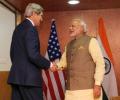
Elaborating on America and India's scope of engagement, Kerry said he has seen first-hand the transformation in Indo-US relationship as well as the ups and downs in the relationship. Kerry says the world's oldest and largest democracy were "finally beginning to captalise on our connections to each other." Sheela Bhatt/Rediff.com reports after the media interaction with the US secretary of state.
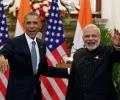
'At a time when the entire India-US relationship needs to be defined by President Trump and Prime Minister Modi, a fresh look at the liability issue has become urgent,' says Ambassador T P Sreenivasan, former Governor for India at the IAEA.

Yale University has issued a statement saying that Human Resource Development Minister Smriti Irani attended a weeklong programme and received a certificate from the university last year, along with several other lawmakers from India. George Joseph/Rediff.com reports from New York

It is easy to foretell that negotiating a comprehensive and final agreement on the Iran nuclear issue is by no means an easy task. It involves hard negotiations, but the hardest step has been taken, says Ambassador M K Bhadrakumar, who was among the first group of foreigners to visit the the top-secret Arak plant hidden behind barren mountains south of Tehran.
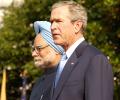
'If we could break through this symbolic barrier of sanctions and a dysfunctional relationship, we could do anything.'

'We are encouraged by what the prime minister said recently on these issues... We will keep a close eye on these issues. They are very important and as are other elements of our human rights and religious freedom.' 'So, absolutely, we'll keep a focus on them.'

20 years ago this day, May 11, 1998, India conducted its second nuclear test at Pokharan in Rajasthan. In a fascinating interview on Rediff.com, K Subrahmanyam revealed how Indian PMs reacted to nuclear ambitions.

Why is Xi Jinping visiting Saudi Arabia, Egypt and China this week? Former RA&W officer Jayadeva Ranade explains the significance of China's outreach to the Middle East.
At no other time has a single meeting of the leaders of two democracies been so critical and hazardous.
